

6 Charts on the State of Enterprise SaaS Vendors
We analyzed 2,000+ buyer discussions across Workday, HubSpot, Salesforce, ServiceNow, Anthropic, Monday.com, and their competitors to quantify where incumbents remain sticky, where AI is driving incremental spend, and where frontier labs are beginning to reshape traditional software markets.
Join our research briefing on September 1 with Qualitate’s Director of Research, Tyler Fein, for a live walkthrough of these results, with Q&A.
Below, we cover:
- Workday’s core platform remains highly sticky
- HubSpot’s upsell base is narrowing, even as AI becomes a bigger driver
- Salesforce’s AI resonates with buyers, but trails the frontier leaders
- Where ServiceNow is losing ground to Microsoft and AI-native alternatives
- Anthropic now shows up in 37 enterprise software markets
- Monday.com is increasingly missing what buyers want
Clients have access to 150+ slides of data on enterprise applications vendors, along with every underlying data point and buyer transcript on the Qualitate platform. Learn more.
1) Workday’s core platform remains highly sticky
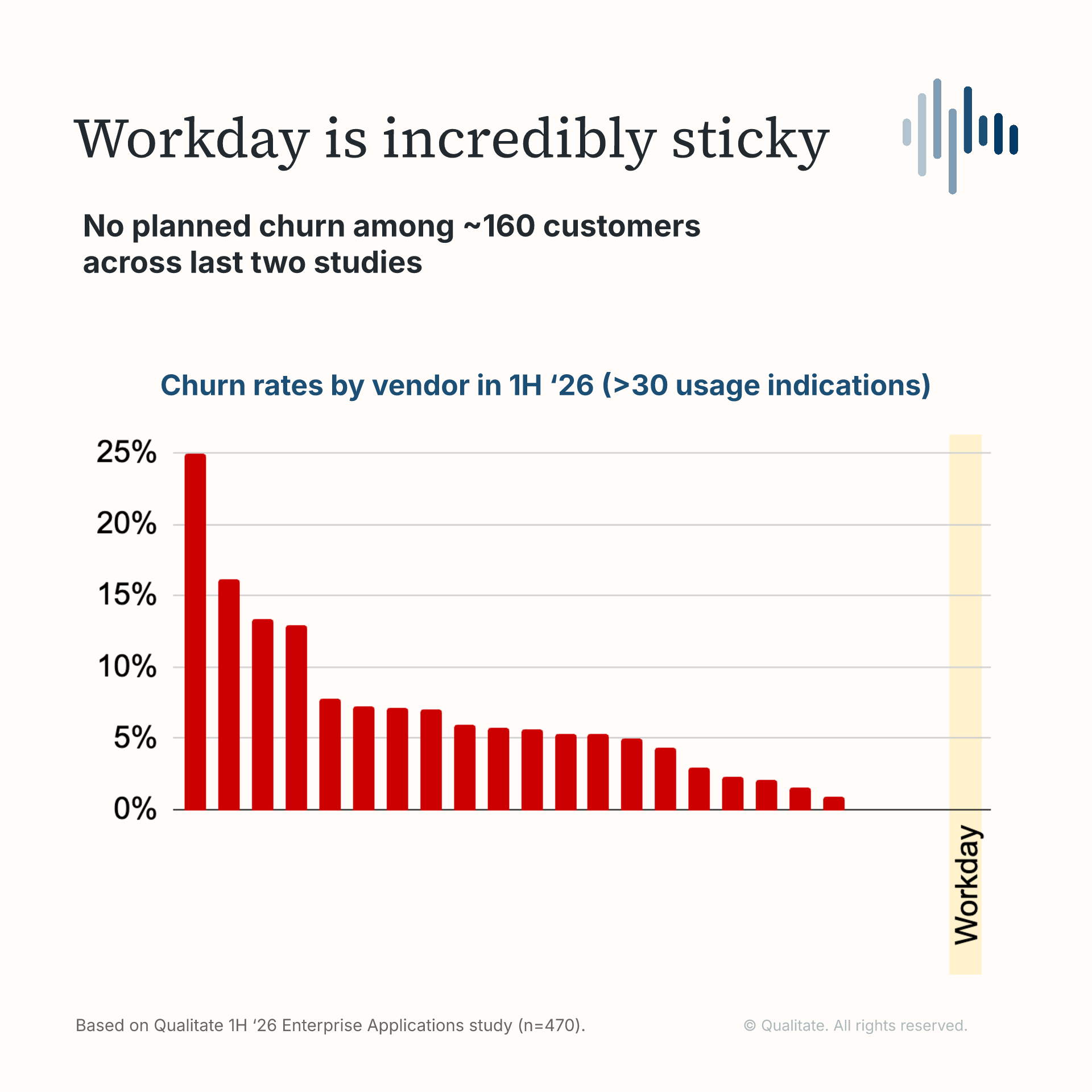
Workday remains one of the stickiest vendors in our enterprise applications coverage. Across roughly 160 customers in our last two studies, we saw no customers planning to churn.
Three factors come up repeatedly as drivers of that stickiness:
- Single source of truth
- Switching costs and embeddedness
- Integration breadth
Our 1H ‘26 enterprise applications study suggests that Workday’s customer relationships today are driven primarily by the strength of its core platform rather than AI. AI-driven upsells remain relatively limited, while buyer reviews of Workday’s AI capabilities are roughly in line with the broader space.
2) HubSpot’s upsell base is narrowing, even as AI becomes a bigger driver
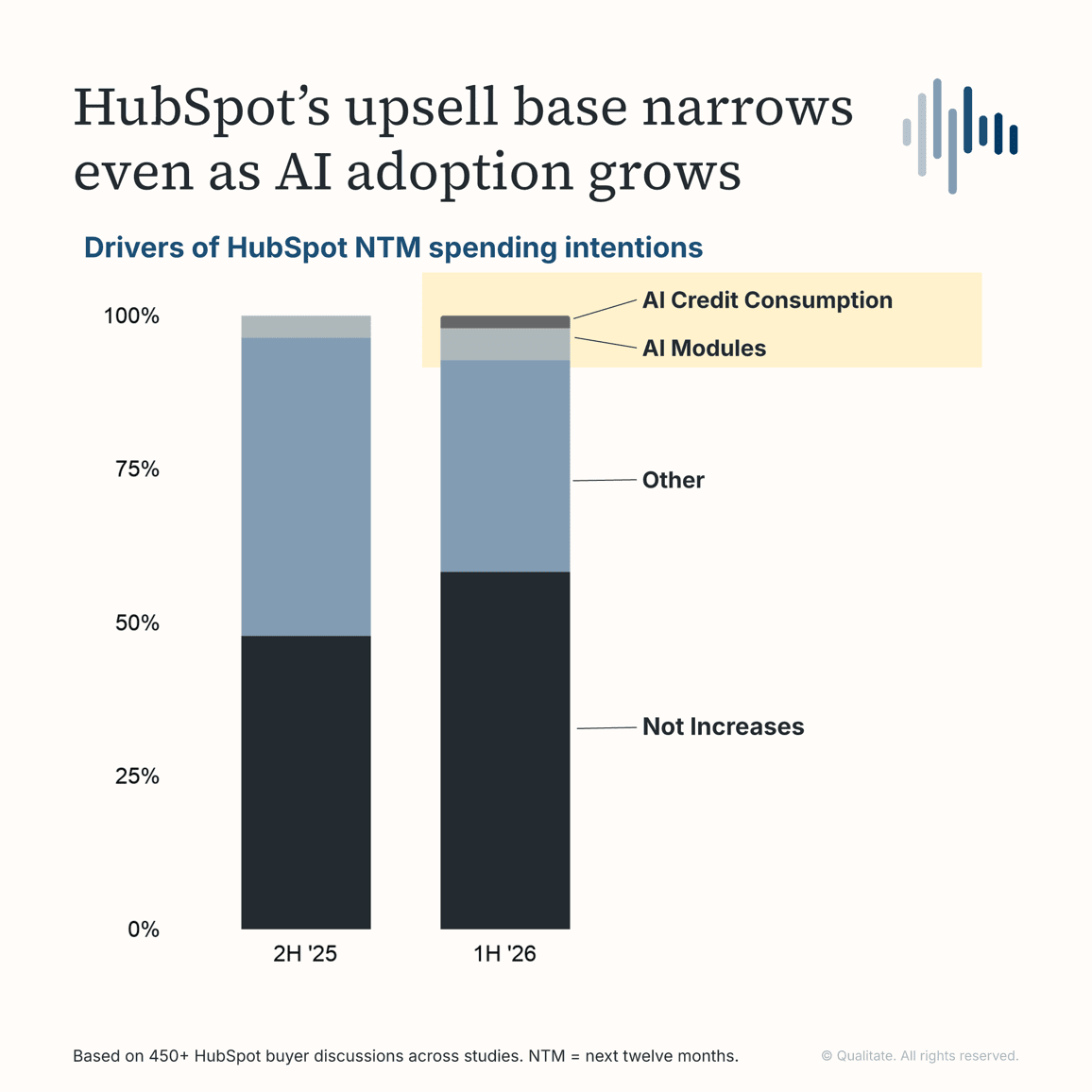
In our 1H ‘26 study, more HUBS customers cited plans for flat next-twelve-month (NTM) spending than in the 2H ‘25 study.
But among the customers who are increasing spend, AI is a bigger slice of the reason. AI module adoption drove ~6% of increases, while AI credit consumption drove ~3%, the latter up from zero mentions in 2H ‘25.
“I would say budget expansion is completely independent of user seats or licenses, just heavily driven by AI forecasting module consumption credits.” – Founding GTM Account Manager, IT & Telecom, Midsize Business
In short, our data suggests HubSpot’s upsell base is narrowing even as the AI portion of it grows.
3) Salesforce’s AI resonates with buyers, but trails the frontier leaders
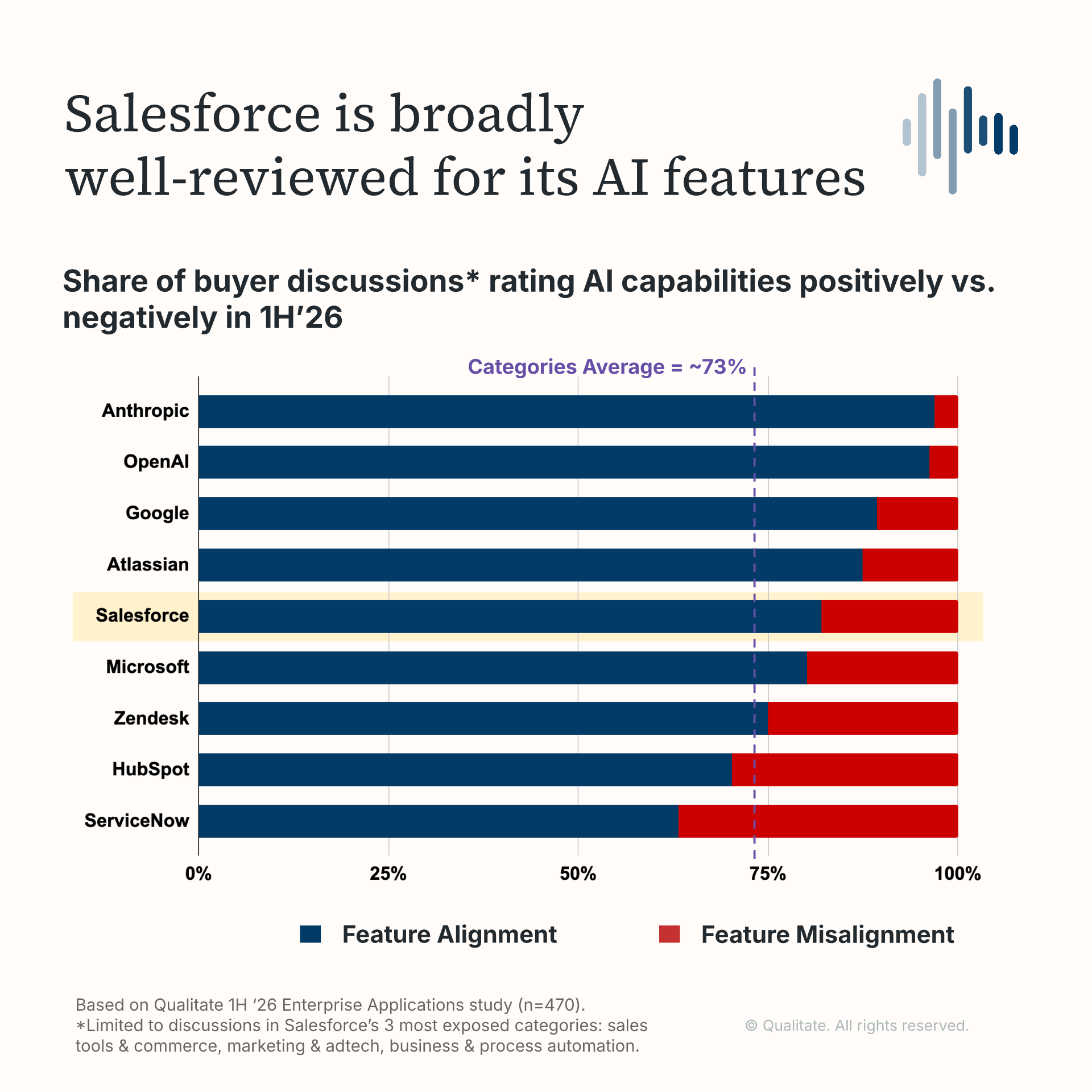
Salesforce’s AI capabilities came up favorably in roughly 82% of buyer discussions across its three core markets, stronger than the industry average of about 73%, based on our 1H ‘26 enterprise applications study.
Einstein and Agentforce are doing most of that work:
“It has got the strongest AI suite… it has got a very high ROI from service efficiency, automation, and unified customer data.” – Director - Data Governance & Data Integration, Retail, Large Enterprise
But negative sentiment clusters around “bolt-on” concerns:
"I didn’t see the worth of AI in Salesforce. You know, everything was an add-on. It wasn't integrated well." – VP of Operations, IT & Telecom, Small Business
Salesforce trails Anthropic, OpenAI, Google, and Atlassian on AI feature alignment in its own served markets.
4) Where ServiceNow is losing ground to Microsoft and AI-native alternatives
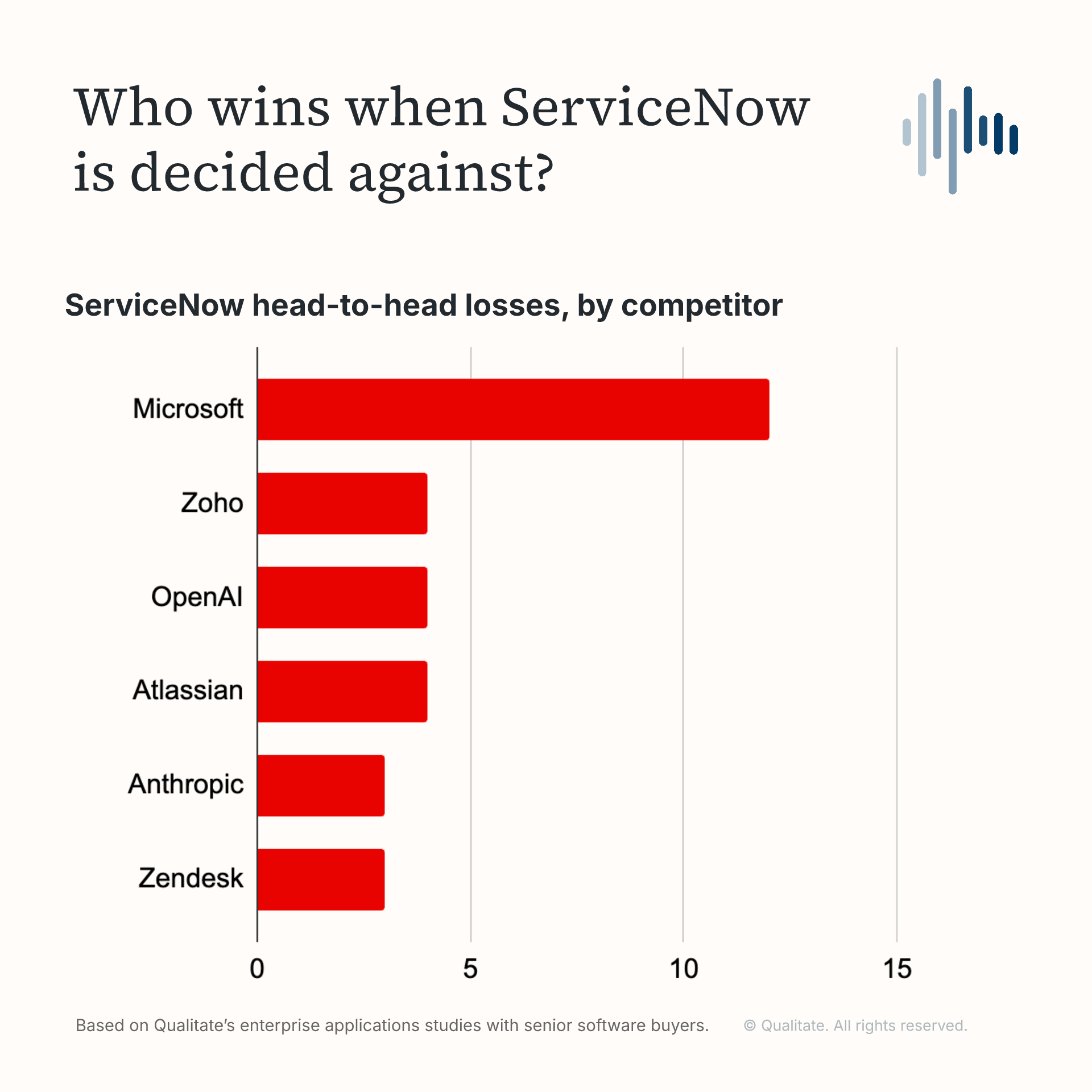
ServiceNow’s conversion worsened study-over-study in our data, with the vendor most frequently losing evaluations to Microsoft - and increasingly facing a different kind of competition from AI-native vendors.
The weakness is most pronounced among SMBs. Complexity comes up disproportionately as a reason buyers decide against ServiceNow in the segment, where conversion is well below what we see among large enterprises.
At the same time, some buyers are bypassing traditional workflow software altogether. Rather than purchasing another application layer, they are building directly with frontier models such as ChatGPT and Claude - particularly when the goal is agent building rather than workflow automation:
“Zendesk, Intercom, Freshworks, and ServiceNow are just too clunky for us. You still have to build an interface to knowledge inside... We have enough skill sets inside the company to build a chatbot using ChatGPT or flip it over to Claude.” – CEO, IT & Telecom, Small Business
“We are primarily looking to increase the spend on native AI tools like OpenAI and Anthropic... We did look at ServiceNow, where it is more workflow automation, not really agent building... ServiceNow is not really capable of that.” – Senior Security Engineer, Financial Services & Insurance, Midsize Business
5) Anthropic now shows up in 37 enterprise software markets
Where AI vendors are showing up in our software disruption matrix, the most notable disruption is coming from the frontier labs themselves.
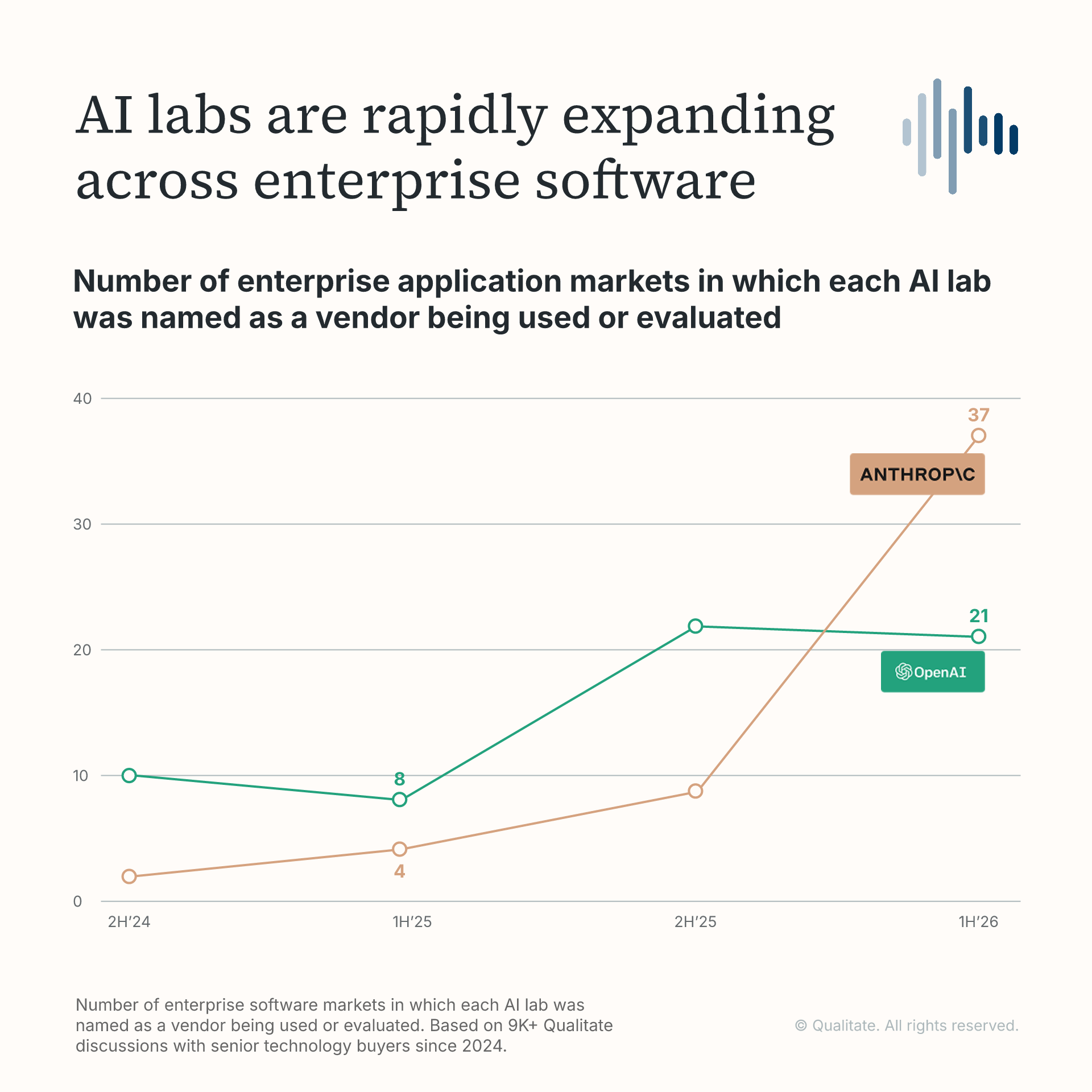
Anthropic was named as a vendor being evaluated or used in 37 enterprise application markets in 1H ‘26, up from 4 markets a year prior.
A year ago, Anthropic mentions clustered in customer service automation & AI. Since then, its usage share has continued to grow in that core market, while its footprint has expanded into adjacent categories. Anthropic now ranks #3 in usage in wireframing & product design, for example.
OpenAI started from a higher base and has held roughly flat, while Anthropic’s footprint has climbed steeply.
6) Monday.com is increasingly missing what buyers want
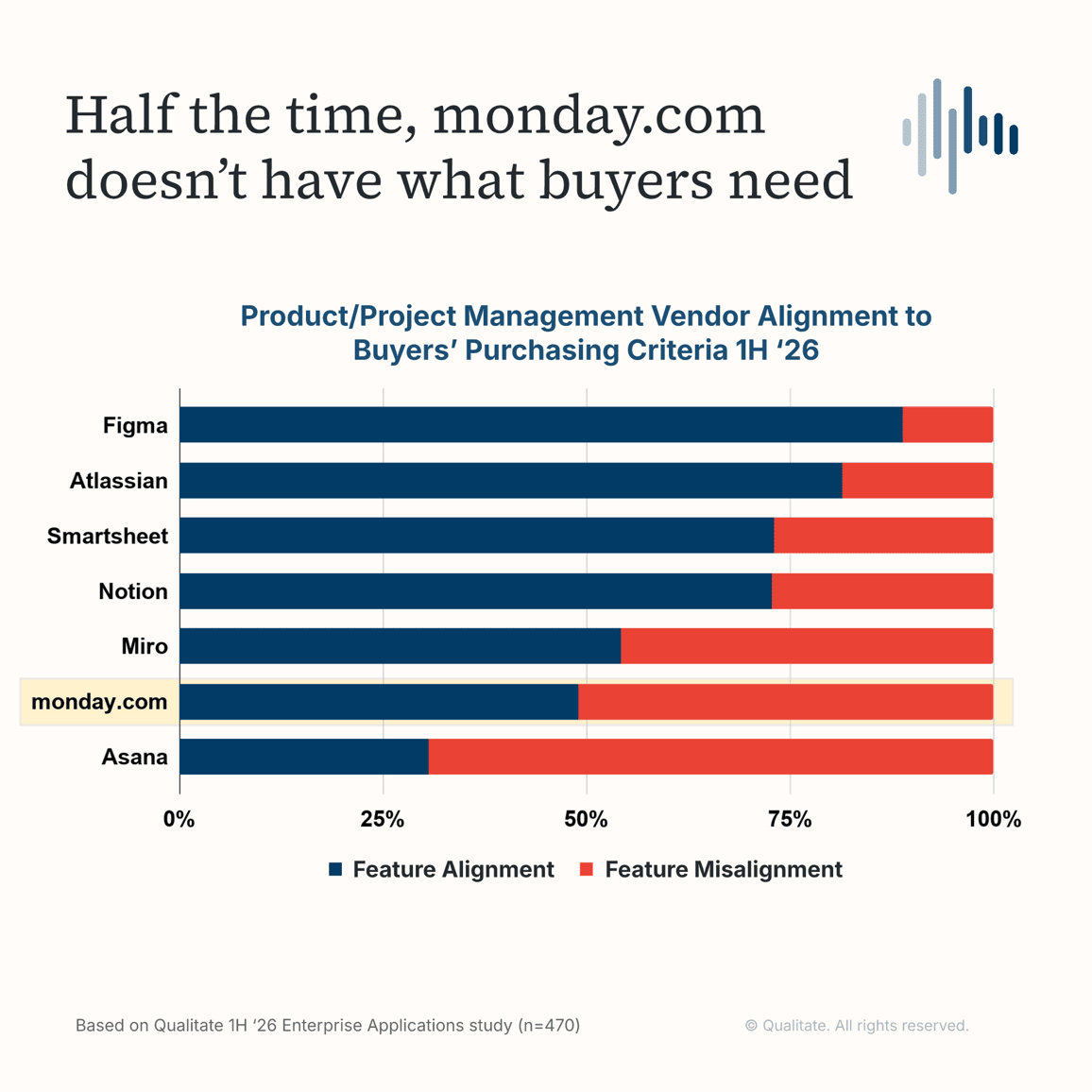
Monday.com had what buyers were looking for in <50% of 1H ‘26 discussions, second-lowest among the collaboration vendors we track and well below Figma at ~90%.
We measure this as feature alignment, or how well a vendor matches the criteria buyers say drove their decision. Monday’s feature alignment has trended downward in our last two studies, with integration and AI capabilities among the misses. Conversion, Spend, and Evaluations all trail competitors.
In its recent earnings report, near-term uncertainty around its recent restructuring and cautious guidance sent shares down, despite a revenue beat.
Further reading:
Subscribe to the Qualitate newsletter
.jpg)
.png)